- Fill out Record Sheet from the start! Record:
- Warp Yarn size, brand, and color.
- Sett
- Length Warped
- Width Warped
- Width in Reed
- Draft
- Sample 2" each of each possible weft colour, weave at least 2 samples, or plan to cut the sample into 3-4 pieces. This will allow you to also sample finishing techniques.
- Sample at a finer sett, just to see if the drape is better for the end product.
- Sample at a looser sett, again to see how this effects the drape of the final cloth.
- Sample different treadling orders than you originally planned. Remember there are 75 sheds on a 4 shaft loom! See my upcoming Cyber Fiber Class on Weavoltuion.com
- Finally, wet finish your samples, I do this as they come off the loom for more instant gratification! :) I wet finish with just boiling hot water and an eco detergent, another with boiling hot water and low agitation, in the washer on high heat on the delicate cycle, and if I'm really feeling bold on a full cycle hot temperature. I drink a lot of tea while wet finishing, more on wet finishing specially later. :)
Wednesday, 24 December 2014
Sampling Procedures

Monday, 22 December 2014
The Importance of Sampling.
As I am enjoying a wonderful holiday break from work. I have more time to spend in my studio, aka afternoon nap time. I am working on my son's cloth, but I am also working on the sample for my next mundane project. This project is inspired by Van Gogh's Wheatfields. I have chosen many possible warp colours, but obviously must also decide on the weft colour(s) and finalize other design elements. Enter sampling!
I admit about 10 years ago, I was one of those weavers who would make disparaging remarks about sampling. However many years ago, I was shown the value of sampling. Sampling is not a wast of yarn, in fact it is quite the opposite. The sample I am now weaving will provide more information that one might imagine. It will show me exactly how every colour will interact with one another. It will show me how my intended sett will drape. It will tell me how much shrinkage to expect, and let's face it who can afford to be wrong about shrinkage?! We've all done it, refused to sample to save yarn, only to end up not warping enough width or length and having to change plans on the use of our handwoven cloth! So if you have not yet seen the value of sampling, I urge you to make your 2015 resolution to sample, sample, sample! Keep good notes, keep your samples for reference and you will build a library of inestimable value!
I admit about 10 years ago, I was one of those weavers who would make disparaging remarks about sampling. However many years ago, I was shown the value of sampling. Sampling is not a wast of yarn, in fact it is quite the opposite. The sample I am now weaving will provide more information that one might imagine. It will show me exactly how every colour will interact with one another. It will show me how my intended sett will drape. It will tell me how much shrinkage to expect, and let's face it who can afford to be wrong about shrinkage?! We've all done it, refused to sample to save yarn, only to end up not warping enough width or length and having to change plans on the use of our handwoven cloth! So if you have not yet seen the value of sampling, I urge you to make your 2015 resolution to sample, sample, sample! Keep good notes, keep your samples for reference and you will build a library of inestimable value!
Saturday, 13 December 2014
Fibre Interest Group Banner Project
For those who don't know HL Isabella Maria came to me a few years ago with a wonderful idea for the Insulae Draconis fibre artists! Her idea was for us to design a banner which would commemorate Fayre Raglan, one of the Principality's most loved events and sites, and would also allow a variety of people to participate in the project and show a variety of fibre arts.
I agreed to organize the project and was lucky enough to find Lady Agatha and Lord Kit, who agreed to work together on a design.
Agatha and Kit came up with a wonderful design. The centre panel will be made of a scene depicting Raglan Castle and the many activities that occur throughout the Farye, such as cooks working at a bread oven, fencing, battles, tents, etc. These designs were based on (INSERT INFORMATIOn HERE). This panel will have a tablet woven border that separates it from the heraldry of each Shire in the Principality. The corners of the woven border are quarter suns in spelndour, to represent the Principality. Another tablet woven band will surround these embroidered slips as well.
 The slips that will comprise the centre panel have been given out to individual embroiders who reside in the Principality. Each Shire's device has been entrusted to a member of each Shire. We hope that every member of the shire will take a turn putting a few stitches in the group's heraldry. Shires were provided with wool to use in embroidering their heraldry. and were asked to use outline and chain stitch so these slips are consistent with one another. The embroiderers of the centre slips have provided their own embroidery materials, but were provided with cloth to use, to keep the slips approximately the same weight. These embroiderers are choosing the techniques they think suit their slip best.
The group has made very good progress. Duchess Fiona, Mistress Mary, and Lady Edith has returned some lovely centre slips. Fiona and Edith have even volunteered to do a second slip! Thus far, I know Flintheath and Klakavirki are complete. Lady Catherine weaver has provided many meters fo tablet woven bands to trim the banner as well. One of the nicest things about this project have been hosting times at Raglan for people to work on the project. The first year, when everything was just beginning a number of people from outside the Principality showed up and asked if they could help! It is great to see from the very beginning that this project is inspiring to others. Since we have made good progress thus far and we will beginning sewing the finished pieces onto the banner soon. If you would like to help out in any way, please do contact me.
I agreed to organize the project and was lucky enough to find Lady Agatha and Lord Kit, who agreed to work together on a design.
Agatha and Kit came up with a wonderful design. The centre panel will be made of a scene depicting Raglan Castle and the many activities that occur throughout the Farye, such as cooks working at a bread oven, fencing, battles, tents, etc. These designs were based on (INSERT INFORMATIOn HERE). This panel will have a tablet woven border that separates it from the heraldry of each Shire in the Principality. The corners of the woven border are quarter suns in spelndour, to represent the Principality. Another tablet woven band will surround these embroidered slips as well.
The slips that will comprise the centre panel have been given out to individual embroiders who reside in the Principality. Each Shire's device has been entrusted to a member of each Shire. We hope that every member of the shire will take a turn putting a few stitches in the group's heraldry. Shires were provided with wool to use in embroidering their heraldry. and were asked to use outline and chain stitch so these slips are consistent with one another. The embroiderers of the centre slips have provided their own embroidery materials, but were provided with cloth to use, to keep the slips approximately the same weight. These embroiderers are choosing the techniques they think suit their slip best.The group has made very good progress. Duchess Fiona, Mistress Mary, and Lady Edith has returned some lovely centre slips. Fiona and Edith have even volunteered to do a second slip! Thus far, I know Flintheath and Klakavirki are complete. Lady Catherine weaver has provided many meters fo tablet woven bands to trim the banner as well. One of the nicest things about this project have been hosting times at Raglan for people to work on the project. The first year, when everything was just beginning a number of people from outside the Principality showed up and asked if they could help! It is great to see from the very beginning that this project is inspiring to others. Since we have made good progress thus far and we will beginning sewing the finished pieces onto the banner soon. If you would like to help out in any way, please do contact me.
Monday, 8 December 2014
Royal Artisan
I am pleased to announce that at Drachenwald's Kingdom University, I was invested as Drachenwald's Royal Artisan. I obtained this new position by completing the yearlong Royal Artisan Competition. I would like to share my experience entering the competition with you.
The Royal Artisan Competition is a rigorous competition. I had to enter items in at least 3 broad categories over at least 2 events. The categories are now Culinary Arts, Fine Arts, Textiles Arts, Performance, Martial Arts, Decorative Sciences, Functional Sciences, and Research Papers. Within each category there are a number of criteria for specific entries. I hope you will find the explanation of my entries below helpful in understanding the criteria of the competition.
 I started my competition year by entering a set of hoods made for my family. These hoods are made from my own handwoven cloth, see a photo of my husband's to the left. These hoods were entered in the Textile Arts category, to be judged using the Accessories, Clothing criteria.
These hoods were exceptionally fun to make. I started with a simple herringbone weave, but got bored with straight treadling and decided to reverse the treadlining. I measured how far I wove before the first reversal and continued with this throughout the weaving. The effect is a nice herringbone wool with diamonds every 6".
The hoods are based on the Skjodlhamn find from a Norwegian harbor. The design is very close to the extant hood, for more detailed information on this find please see Løvlid's dissertation. The hoods are the closest thing I could find to a "Viking" hood, though they are a bit late to be considered Viking in the strictest sense, but they are within the period that my husband chose to recreate. These hoods are made from J.C. Rennie wool in grey (warp) and blue (weft). For more information on this project, see my blog entry here.
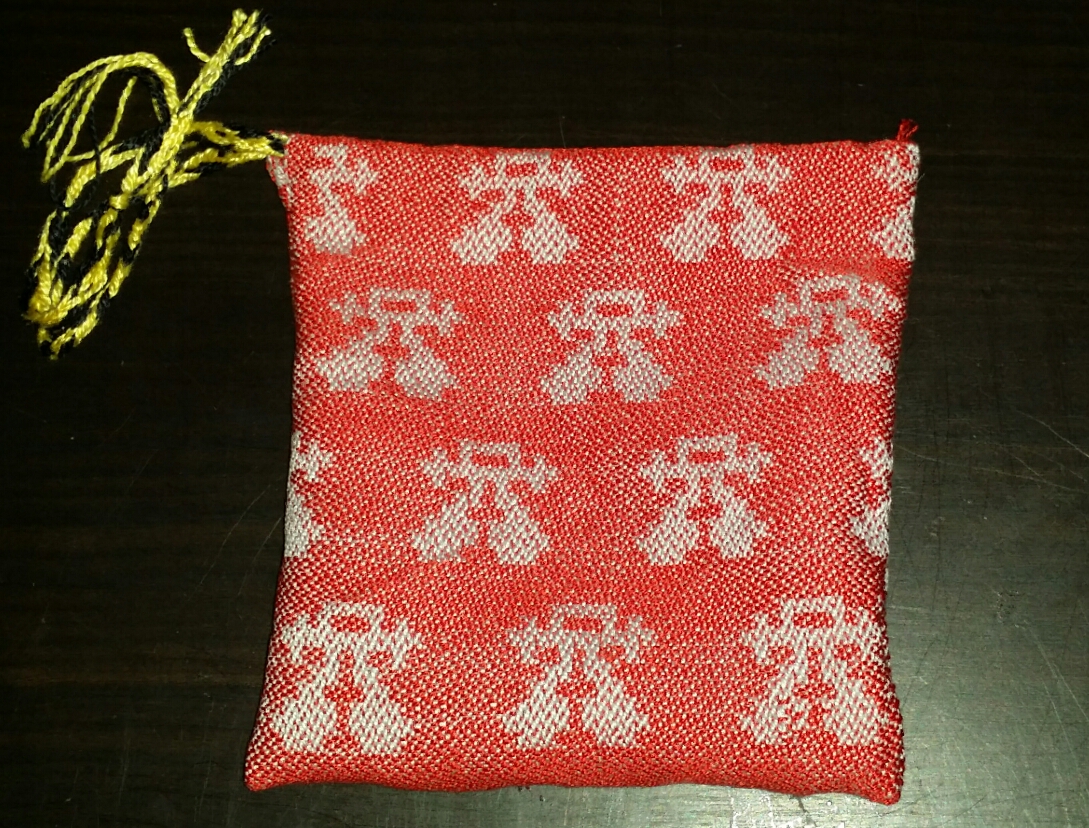 My second entry was a damask pouch, right, I wove for Margaret de Mey as a present to celebrate her elevation to the Order of the Pelican. This pouch was entered as heraldic display. My judges were very kind and as I have spoken to several heraldically inclined individuals, they have all commented on their love for heraldic display in items other than banners! The pouch itself was based on a heraldic purse on display at the British Museum and an article on Cote Simple, on aumonieres.
This project was very fun as well. The damask cloth was woven on my drawloom and was one of my first projects using the drawloom attachment. I had to do a lot of sampling to draft the design to get the water bugettes just right, but I go there in the end and the journey was well worth it.
My final entry was in the Research Paper category. This paper is thus far the culmination of many years of research on Medieval textiles and loom technology. I discovered that I have a vast library of books pertaining to Medieval textiles and learned many new things while reviewing the literature for this entry. I also visited the newly formed Clothworker's Centre in London to view a few new textiles to add to the paper. As part of the research paper, I included a number of samples of my own weaving to help people understand the various different weave structures I have documented and the weaving terminology. This entry was probably the most difficult entry, but again was a joy to complete and is a work of which I am very proud. I plan to bring the samples with me to events, so if you would like to see all the samples, please find me at events and I would be happy to let you peruse them.
Overall the competition was a rigorous, but fun experience. I look forward to helping our fine Royals in any special projects they would like completed and in encouraging Drachenwald's artists. If you have ever considered entering the competition, I would encourage you to do so. This was not my first time entering the Royal Artisan Competition. I have had some wonderful feedback along the way and have made many new acquittances from people judging my work and coming to ask questions or give compliments after the competition. If you have any questions about the competition or my experience, please ask!
The Royal Artisan Competition is a rigorous competition. I had to enter items in at least 3 broad categories over at least 2 events. The categories are now Culinary Arts, Fine Arts, Textiles Arts, Performance, Martial Arts, Decorative Sciences, Functional Sciences, and Research Papers. Within each category there are a number of criteria for specific entries. I hope you will find the explanation of my entries below helpful in understanding the criteria of the competition.
These hoods were exceptionally fun to make. I started with a simple herringbone weave, but got bored with straight treadling and decided to reverse the treadlining. I measured how far I wove before the first reversal and continued with this throughout the weaving. The effect is a nice herringbone wool with diamonds every 6".
The hoods are based on the Skjodlhamn find from a Norwegian harbor. The design is very close to the extant hood, for more detailed information on this find please see Løvlid's dissertation. The hoods are the closest thing I could find to a "Viking" hood, though they are a bit late to be considered Viking in the strictest sense, but they are within the period that my husband chose to recreate. These hoods are made from J.C. Rennie wool in grey (warp) and blue (weft). For more information on this project, see my blog entry here.
My second entry was a damask pouch, right, I wove for Margaret de Mey as a present to celebrate her elevation to the Order of the Pelican. This pouch was entered as heraldic display. My judges were very kind and as I have spoken to several heraldically inclined individuals, they have all commented on their love for heraldic display in items other than banners! The pouch itself was based on a heraldic purse on display at the British Museum and an article on Cote Simple, on aumonieres.This project was very fun as well. The damask cloth was woven on my drawloom and was one of my first projects using the drawloom attachment. I had to do a lot of sampling to draft the design to get the water bugettes just right, but I go there in the end and the journey was well worth it.
 |
| Photo courtesy of Lia de Thornegge |
Overall the competition was a rigorous, but fun experience. I look forward to helping our fine Royals in any special projects they would like completed and in encouraging Drachenwald's artists. If you have ever considered entering the competition, I would encourage you to do so. This was not my first time entering the Royal Artisan Competition. I have had some wonderful feedback along the way and have made many new acquittances from people judging my work and coming to ask questions or give compliments after the competition. If you have any questions about the competition or my experience, please ask!
Saturday, 4 October 2014

Tuesday, 12 August 2014
AS 50 Challenge
Although I don't post about it often, I am working on the AS 50 Challenge. If you are not in the SCA, next year marks the 50th anniversary/birthday of the Society. A challenge was issue many years ago for artisans to complete 50 projects, parameters of their choosing, by the 50th anniversary event. I challenged myself to weave 50 things. Today, I am taking stock of my progress.
Here is a list of what I have woven since taking up the challenge.
Here is a list of what I have woven since taking up the challenge.
1.Belt for Magdalaina
2- 3. Lattice work garters for Comtesse Margarette de St. Martin-sur-le-Mer (2)
4. -11. Tokens for ID Viceroy teachers 7 completed
12.-14. 3 Rigid Heddle Bands for Viceroy A&S Prizes- 2 lengths approximately 1.5 yards each. One will be cut up as tokens to be given by the populace. The longer, nicer band, will be given as the prize for the overall winner of the A&S Competition. The bands are approximately 1" wide. The piece that will stay in tact could be used, by the competition winner, as a head band, to trim some sleeves, or a bag, etc.
The design is not based on any extant designs, but could have been created using a rigid heddle in the Middle Ages. The bands are woven in Shetland Wool from the Handweaver's Studio in London.
15. Rigid Heddle Sampler this sample has been important for choosing colour combinations in future projects. Sampling is an important part of professional level weaving and likely was a large part of an apprentice weaver's day.
16. Tapestry Roundel Sample, woven in the William Jeffries workshop, this was good prep for a project I still have planned.
17. Green & Gold Straight Twill 3 yards<
18. Purple and Gold Horizontal Herringbone Shawl
19-20. Purple and Gold bags for Drachenwald Gift Basket to Calontir year?
21-22. Woven Cloth for Drachenwald Gift Bags Pennsic year?
23 Cloth for Organizer of the Gift Basket Project, thus was a personal gift.
24. Rigid Heddle Woven Bag for Salonge in houndstooth
25. Double Weave Bag for Gift for Ashunpudle
26-27. Herringbone Leg Wraps for Eldgrimr
28. 1/2 Lozenge Twill Cloth for Eldgrimr's Hood, yellow and red hood
29. Rigid Heddle Blanket for Siubhan
30. Herringbone Hood for Eldgrimr
31. Herringbone Hood for me
32. Herringbone Hood for Thor
33. Herringbone Shawl
34-35. Warp faced bands for bags
36. Damask Sample of clovers, possible gift for Sir Clancy
37. Damask woven pouch for Mistress Margaret de Mey
38. Cloth for Delia, which we made into a rahter nice tabard. She has enough left to make into a nice script as well.
2- 3. Lattice work garters for Comtesse Margarette de St. Martin-sur-le-Mer (2)
4. -11. Tokens for ID Viceroy teachers 7 completed
12.-14. 3 Rigid Heddle Bands for Viceroy A&S Prizes- 2 lengths approximately 1.5 yards each. One will be cut up as tokens to be given by the populace. The longer, nicer band, will be given as the prize for the overall winner of the A&S Competition. The bands are approximately 1" wide. The piece that will stay in tact could be used, by the competition winner, as a head band, to trim some sleeves, or a bag, etc.
The design is not based on any extant designs, but could have been created using a rigid heddle in the Middle Ages. The bands are woven in Shetland Wool from the Handweaver's Studio in London.
15. Rigid Heddle Sampler this sample has been important for choosing colour combinations in future projects. Sampling is an important part of professional level weaving and likely was a large part of an apprentice weaver's day.
16. Tapestry Roundel Sample, woven in the William Jeffries workshop, this was good prep for a project I still have planned.
17. Green & Gold Straight Twill 3 yards<
18. Purple and Gold Horizontal Herringbone Shawl
19-20. Purple and Gold bags for Drachenwald Gift Basket to Calontir year?
21-22. Woven Cloth for Drachenwald Gift Bags Pennsic year?
23 Cloth for Organizer of the Gift Basket Project, thus was a personal gift.
24. Rigid Heddle Woven Bag for Salonge in houndstooth
25. Double Weave Bag for Gift for Ashunpudle
26-27. Herringbone Leg Wraps for Eldgrimr
28. 1/2 Lozenge Twill Cloth for Eldgrimr's Hood, yellow and red hood
29. Rigid Heddle Blanket for Siubhan
30. Herringbone Hood for Eldgrimr
31. Herringbone Hood for me
32. Herringbone Hood for Thor
33. Herringbone Shawl
34-35. Warp faced bands for bags
36. Damask Sample of clovers, possible gift for Sir Clancy
37. Damask woven pouch for Mistress Margaret de Mey
38. Cloth for Delia, which we made into a rahter nice tabard. She has enough left to make into a nice script as well.
Weaving Tasks
39. Taquete sample for research paper
40.Samitum samlle for paper/portfolio
41. Cloth for Eldgrimr I'm currently on this project! :)
42. Cloth for Thor
43. Cloth for me
44. Weave Apprentice belt, possible green on green damask
45-46. Damask MoAS Sashes for Kingdom and Principality
47. Woven headband
48. Tablet woven band for ID Fibre Interest Group Banner
49. Knight's belt for Halvgrimr
50. Woven thank you gifts for impromptu thank yous.
Wow only 12 projects left and 10 months to go. We'll see how much work, business, and life gets in the way! I have definitely woven well over 50 yards or meters since starting the challenge. I took the challenge to motivate me to weave more. I think this objective has been achieved. I hope I can fulfill my goal by the deadline, but either way I am a better weaver than when I started! :)
39. Taquete sample for research paper
40.Samitum samlle for paper/portfolio
41. Cloth for Eldgrimr I'm currently on this project! :)
42. Cloth for Thor
43. Cloth for me
44. Weave Apprentice belt, possible green on green damask
45-46. Damask MoAS Sashes for Kingdom and Principality
47. Woven headband
48. Tablet woven band for ID Fibre Interest Group Banner
49. Knight's belt for Halvgrimr
50. Woven thank you gifts for impromptu thank yous.
Wow only 12 projects left and 10 months to go. We'll see how much work, business, and life gets in the way! I have definitely woven well over 50 yards or meters since starting the challenge. I took the challenge to motivate me to weave more. I think this objective has been achieved. I hope I can fulfill my goal by the deadline, but either way I am a better weaver than when I started! :)
Thursday, 31 July 2014
Cloth Reflections
I recently finsihed weaving 4 meters of commissioned cloth for a friend. Although she does intend to use it for re-enactment, she was not particularly concerned with an authentic weave structure. She had seen what I can only really describe as a tabard on a website and really liked the cloth, which was listed as jacquard. Over the course of many months, I drafted a cloth in a similar style, which resulted in an undulating point twill. I originally used 8 shafts, then was able to take it to 4 shafts, which Medieval weavers used.
In the course of being commisioned to weave this cloth my life went a bit topsy turvy. I became pregnant and moved 2 times in the span of 7 months. The first move 1 month before giving birth and the second 3 months after. Needless to say it was nearly a year before I was able to warp uo this cloth. In the meantime, I "accidentally" bought a Glimakra Ideal on Ebay. I decided this cloth should be my fiest cloth on the Ideal.
So off to warp the new loom I went, no biggie I had become quite accomplished at warping. Well acconplishment comes with practice, which I had not had recently. Thus started a series of warping mistakes, which were likely a result of being out of practice and deciding to use my warping board bottom to top. The catastophic mistakes I discovered before the warp went on the loom. I had skipped a peg on the warping board. The first bout I wound again. The second I was able to fix on the board. The final issue I faced was a twist in several warp bouts. I noticed this before threading and properly fixed all but one. I thought I had fixed them all properly, but the last twist was not apparent until the warp was under tension. I weave with the lease sticks in and decided to kerp my fingers crossed and hope for the best. After weaving .5 meter sample to allow my friend to make a final choice of weft colour, I was confident I could make it through the rest of the warp. I was correct. Since the twist was behind tge lease sticks, my experience allowed me to carefully seperate the warp and move tge lease sticks back. This made weaving take a bit longer, but probably not as long as the otger options.
Once the cloth was all warped up and the decision was made to soldier on, I was a bobbin and a weavin'. One of the things which really sank in while weaving this cloth, was the impirtance of winding a good bobbin. A well wound bobbin not only speeds up the weaving, but also helps keep selvedges even. A poorly wound bobbin will catch and come to an ubrupt halt. This can cause several problems. First the sudden halt will pull in the selvedge more. It will also cause the bobbin to jump in the shed, which may result in the bobbin going over and undr tye wrong threads. Finally it will waste time in having to reach in the shed to retrievw thw bobbin. I realized how important well wound bobbins are, because I wound my bobbins quite well this time and thus experienced to true joy of weaving with good bobbins!
I inititially used an aide de memoire to help me track my treadling. I treadled the cloth straight through 3 times, then treadled backwards 3 times. I think a small abacus would be a useful medueval tool to use for this purpose. By the time this occured to me, I had feel into a goid rhythm and found myself rarelt using the aid.
Finding your rhythm in your weaving is essential to efficient weaving. It also produces a very pleasant weaving experience. Finally, a rhythm allows you to reach a meditative state. This is one of thw tru joys of weaving and can be found in every step of weaving.
Finally there are 3 places in the 4 meters which areb't quite right. I could not decide if these are missed picks or picks which were improperly packed. In the grand acheme of things 3 picks of approximately 1500 picks isn't much of a flaw. They are only visible on one side, which is odd. I am exceptionally pleased with the cloth. I look forward to my Laurel having a look at it and giving me feedback.
For now I will just say ta ta!
Friday, 25 July 2014
Progress for the sake of accomplishment.
As a working mother, I have to plan the time my son sleeps carefully. I spend every one of his waking minutes with him, unless I'm at work, there's an emergency, or a rare opportunity. Recently, I've been using GTasks to do this. But that's the boring big. My two main weaving goals right now are weaving the cloth bought by a friend and a research paper on cloth in Europe and the Middle East from the 1st to the 14th C.


As of today I have woven about 30" of 5 meters. I would really like to have this done by the time we leave for a week in Wales. I have 8 days yo meet this goal, which means 21" per day. See what I mean about planning? If I don't calculate things like this then I won't meet my goals.
My research paper will include samples of tye weaves discussed. I have most of the samples woven. I need to weave samples of the more obscure weaves. I am currently in the process of revising about 35 pages of text and tieing a cotton warp onto the failed linen warp, picture below. I can document both for taquete and samitum, but the peak of the pattern harnesses is not conducive for linen warps. Once I can extend my loom more linen should work. For now it's cotton.
Wish me luck getting tied on before we go too!
Sunday, 20 July 2014
Thoughts on Spinning
 Those of you who follow me elsewhere will know I spent about a month traveling around the US. I did quite a bit of spinning while traveling, because weaving just does not fit easily in an airline suitcase. Yes there are looms that will, but i have leant those out or have group projects on them at the moment. You will also know that since my return to the UK I have been having a hard time getting to sleep at an hour which is normal for me! My toddler is a 5-6 am wake up kind of kid, so I need to get to sleep early. I find my mind very active between 21:00 and 0:00 these past few nights. One of the things I have been thinking about is spinning and, unsurprisingly, weaving.
Right: the yarn I spun on our way from Vegas to Salt Lake City.
I was recently pondering my spinning and why it fits my life more easily now. As a working mom, it is far easier for me to take a drop spindle to work and do a bit of spinning on my breaks. A drop spindle is also easier to carry around while spending time outdoors with my son.
 Me spinning and chasing TAJ at the cabin.
We assume the children were taught to help with chores as soon as they were able, which was likely far sooner than they are now. Abby Franquemont writes that Andean children were taught to spin as soon as they could sit up on their own! I'm hoping to learn the trick of this form her next weekend! I would love to teach TAJ to spin. He loves watching my spindle and this past summer began to turn the spindle for me, though his method is a bit more batting the spindle than turning/flicking the spindle, we'll see what we can do.

Spindle from Wild Craft's Spindle and Fibre Club 2014
As spinning and weaving technology advanced and they became more mechanized and organized into guilds, it is assumed they became male dominated professions. Some of this may have been due to the prevailing attitudes of the time, but I think some of this has to do with the arts becoming less compatible with the rearing of children. I used to be a far more productive weaver. I had hundreds of hours to while away at the loom. Now those hours are spent with my son, who as previously stated loves to watch me spin and in fact weave too. Although he likes to watch me do these things, he does eventually want to help. He is able to help spin, a bit, but his intended aid and small attention span takes me away from spinning or weaving much sooner than I would on my own. I do not weave on a vertical loom often, mostly for tapestries which I intend to focus on eventually, but cloth always draws me back. Vertical looms, as we know were used by Norse weavers, are more easily left at any interval and picked back up. I can imagine Norse weavers with talismans which would be hung on the next heddle rod to quickly mark one's place. This is not so easily done on a treadle loom. I can simply stand up from my horizontal loom and walk away but unless I have left it at the starting point it takes a bit more time to figure out where I was when I left. So now we find ourselves back at the beginning, I spin more often now, because it is easy to do while also spending time with my son. I rarely however spin on my wheel. Anyone who has spent more than 5 seconds with a child will know why, if you have a child and a big spoked wheel turning round and round the child will stick their hand in the wheel. This will of course end in tears. Children are creatures of habit so to speak, and although they do learn, I'm not yet ready to find out how many times my son would stick his fingers in the wheel before he learned not to do so again!
So there you have it my thoughts on why, as spinning and weaving progressed they became more a man's profession than a woman's. I am happy that we all enjoy these hobbies together now. It is pleasing that they are predominantly women's hobbies now, but the men who join in are good crack and teach us just as much as our fellow woman.

Tuesday, 13 May 2014
Whirling Thoughts

I actually learned to spin when I was quite young. I joined the 4H club, sheep are cute and so my mother became the leader of the Sheep Group. My parents also kindly bought me 4 ewes and eventually one feisty ram. Well as you can imagine you can buy sheep, put them in a lot, feed and water them, breed them and then what? Well being the group leader my mom bought a spinning wheel at an auction.
So when it came time to shear our sheep we kept our wool spent days washing it, even more days carding it and headed off to the spinning wheel. I don't remember anyone actually teaching us to spin, we just did it! I was maybe 9 or 10 so I thought our homespun was lovely. Though after a while I will admit I spent more time at the wheel treadling it with no wool than anything else, but I was a kid, you forgive me right?
By my 20's I had joined the SCA! One of my friends was offered his knighthood and many of the people in my household set out to offer what skills they could to help make the accouterments ever knight needs. I went to visit my parents and asked my mom if I could borrow her spinning wheel. She was delighted to see me using it again, we packed it up in my station wagon and after a lovely visit I went off home to the Ozarks with it. Well the wheel and I had a much better relationship when I was a kid and being an inexperienced spinner with a looming deadline (yes I was spinning for a weaving project so this is a pun) so I blame our issues on myself. I soldiered on with a few adjustments to the wheel here or there and we finally came to a workable agreement. I spun who knows how much wool, collected onion skins all the while. I eventually dyed my spun wool yellow with onion skins, and red with madder. Why onion skins? Because I couldn't find a definitive answer to what Vikings used for yellow dye, I was a young teacher and they were essentially free! I used this wool to weave a Viking 3 hole tablet weaving pattern, which is not for the faint of heart, and sent it off to those wonderful women who sewed Syr Tarl's cloak. I then had to take the wheel back to mom, as I was moving to England for my next teaching job and did not trust the international movers with my mother's wheel. I brought some spindles with me, but for some reason when I arrived, I decided I wasn't very good at spinning. I look back at the other things I had spun and wonder why I thought this, but again that's a horse of a different colour.
Fast forward to Fayre Raglan 2013, there I am innocently sitting at the Flintheath Encampment happy in my own world where weaving, embroidery and chasing a toddler occupy all my time not spent at work or asleep. In walks Constanza to teach her spinning class. I was not attending of course, I already knew I was not cut out as a spinner, well let me tell you not only can Constanza make a spinner out of anyone, but she will infect you with the love of spinning. This is a good thing, by the way!

So why is spinning so infectious? Or why did it keep coming round in my life? First I think fibre arts are in my blood, I don't think I could get away from them if I tried, my great grandmother was a weaver and I'm sure many other women in my family were before that. Second it really is relaxing, when you don't have a deadline looming! We don't have to spin and weave for our survival, we can do it purely for the pleasure. Yes in the beginning it is a very long process, but if you truly take joy in watching beautiful fibre turn into even more beautiful thread and then even more beautiful art, why would you want to rush?
I have been pleasantly surprised at how quickly I have become proficient and efficient in my spinning. So it does not take me as long to spin a yard/meter of thread as it used to, but I'm not in a hurry to become a production spinner. I love watching the thread grow, seeing the colour interaction in space and gradient dyed yarn or even just undyed yarn. Something happens when you add twist to fibre that makes it beautiful and functional. There is a real joy in taking a raw material spinning it into your own thread and then making a piece of art from art that you made yourself!
So what words of wisdom to I have to in part of the budding spinner? If you live in Insulae Draconis grab Constanza or Catherine Weaver at an event and have them teach you to spin. Not only will you learn everything you need to know about spinning, you will also hear some great stories and have lovely conversations along they way. They are wonderful people. If you don't live here or know them, then buy Abbey Franquemont's Respect the Spindle Book and DVD. She is also an amazing teacher and will easily infect you with the love of spinning.
Spinners are kind caring people, like all textile artists. In my opinion textile artists make the world a better place. Well that's about all my musings for today, stay tuned for A Ram's Tale and further Drawloom Musings, yes there is something on the drawloom. :)
Friday, 18 April 2014
Weave Structures
I am working on a research paper which discusses Medieval Textiles. I have a 13 page outline of notes prepared and am beginning to draft the paper. I believe I will be taking a post out of Tien Chu's blog and am considering blogging this paper. The intent of this method is to write longer items, papers/books, by working in chunks, or one blog post at a time. Assuming I continue in this manner, here is my first chunk, which is not at all the introduction to the paper. Please feel free to give me feedback by commenting on this post.
Weave structures can be categorized in a number of ways. The first aspect weavers often discuss is whether or not the cloth is balanced. Balanced cloth is defined by an equal number of ends per inch (or centimeter) and wefts per inch (herein referred to as picks per inch). Balanced cloth shows the skill of a weaver to control the beat of the weft. Balanced cloth is effect when drape is not a factor. However there are a number of reasons when balancing warp and weft is not desirable. Items that are intended to create drapable clothing, should be woven with slight higher ends per inch than picks per inch. This warp dominance produce a better drape in the cloth. Fabric with an end use that needs to be more stiff, such as, a rugged placemat or book cover, should be woven with higher picks per inch than ends per inch.
Cloth can also be woven as warp faced or weft faced. Warp faced cloth is woven in such a way that the warp threads are the only threads visible in the final cloth. Weft faced cloth is woven such that the weft is the only thread that shows in the final cloth. Tapestries, which are weft faced, are common in medieval textiles.
The weave structure itself plays an important role in the final cloth and will be the main focus of this paper. There are three main structures, which will be introduced here. Each structure can be modified in a number of ways to create a wide variety of textiles. The main structures seen in medieval textiles and studied by modern weavers are tabby (or plain weave), twill, and satin. Structures are normally discussed in terms of their interlacement. A cloth’s interlacement is merely the pattern of how many warp threads a weft travels under and then over or vice versa. It is essentially how the warp and weft interact with each other to create the woven cloth.
Tabby, or plain weave is the simplest of all weave structures. It is simple because the weft passes over one warp thread then under another. You only need a mechanism that creates 2 sheds. The earliest looms had a natural shed, that is the way the loom was warped every other thread was lifte above it’s neighbor.These looms also had a mechanism, normally a heddle rod, which lifted the second set of threads up to create the second shed.
Twill is generally defined as a regular interlacement in which the weft passes over or under at least two warp threads. This interlacement must move in a regular interval and direction (either left or right), which produces the distinct diagonal line associated with a twill cloth. Twills are commonly found in medieval textiles.
A satin interlacement is similar to twill, but with an irregular pattern. Satin weaves move using a regular satin (or move) number, but the direction is inconsistent. This structure was developed to allow the quality of the thread to be the dominant visual element rather than the move sequence being the dominant visual element. Satin is commonly used for silk and is believed to have been developed when silk came into common use, to allow the shine of the silk to be the main visual element of the cloth.
Wednesday, 16 April 2014

Ohh Ebay!!!
Ebay is a harsh mistress, a blessing and a curse. I should say I rarely visit Ebay or buy things there anymore.
At a recent Cambridge Guild Meeting, a few members were discussing buying looms. One member pointed out that, in the UK, floor looms often go unsold and folks can make offers for them after the auction ends and thus get great deals! I think this is good advice for weavers loking for a floor loom.
This was not my experience! I already have a 60" Glimakra Standard, but I wanted a smaller floor loom for another room in the house. So I went looking. I made an offer on a loom bigger than I was looking for, the offer was turned down, no big deal.
Then I saw it!!! A Glimakra Ideal...there were already bids. So I knew if I wanted it, I had to bid. 3 days out it was still less expensive than most used table looms. So I bid and waited, and waited. For 2 days I was the highest bidder. This increased my longing for the loom. With an hour left the bidding fever hit me! I had to have it. Needless to say, I bid more than I initially said I would. I did win the loom and it was still a complete steal. They stopped selling the Ideal in Europe this summer, so you can't buy them new here anymore. My total cost was a fraction of the original retail price.
Oliver kindly drove all the way to the Southern coast to pick it up. A 9 hour day for him. He was rewarded with a big thank you and fish and chips for dinner!
The end result, I have a lovely loom, beautiful bench, several more reeds, temples, and more shuttles than I could ever use. Many of them stick shuttles, which I will sell on to someone who will use them, but not via Ebay.
Ebay, I love you, but you won't see me back for awhile!!!
Friday, 11 April 2014
Taquete Todo!
Ok I admit, sometimes I blog to keep myself organized. Hopefully you have seen my damask samples and 13th C Alms Purse. Damask is woven in a drawloom, but is quite a bit later in period. So now my next adventure in drawloom weaving is taquete then samitum.
So here's where I'm at and where I'm going.
I've wound my warp and beamed it. I have added 4 drawcords to my drawbridge, yes that really is what it's called! I now have 14 pattern shafts.
Here's what I still need to do:
1) Put leveling cords on the drawcords and tie the loops on one side of the cords. (Completed 12 April)
2)Thread the loom. This will initially be threaded. 1, Pattern, 2, Pattern. (Completed 12 April)
3) Sley the reed and tie on.
4) Distribute pattern heddles onto 14 pattern shafts. I'll use the Becky Ashden's method for doing this.
5) Weave away!!!
Wish me luck!
So here's where I'm at and where I'm going.
I've wound my warp and beamed it. I have added 4 drawcords to my drawbridge, yes that really is what it's called! I now have 14 pattern shafts.
Here's what I still need to do:
3) Sley the reed and tie on.
4) Distribute pattern heddles onto 14 pattern shafts. I'll use the Becky Ashden's method for doing this.
5) Weave away!!!
Wish me luck!

Thursday, 10 April 2014
Spinning Spring Cleaning
I've always knew I was a spinner. My mother bought a wheel at an Amish auction when I was 7 or 8. I loved treadling it. I spent hours a day just making it go.
For some reason I have resisted my inner spinner. But 5 years ago when I visited Gotland stopping at little farms looking at lammskins, my inner spinner asked a farm wife "Do you have any sheep hair that was cut off a live sheep?" She didn't speak English well enough to understand "Do you have fleece too?" 40 SEK later I had about 10 lbs of fleece. I gave much of this away, but thanks to my friend Constanza, Abbey Franquemont, and the Spin Doctor, I'm just about ready to spin up what I have left.
I tried cleaning it using the Fermented Suint Method recommended by Constanza. And thanks to the Spin Doctor and Amazon my storage is going from tubs under the counter to duvets bags in the cabinets!
For some reason I have resisted my inner spinner. But 5 years ago when I visited Gotland stopping at little farms looking at lammskins, my inner spinner asked a farm wife "Do you have any sheep hair that was cut off a live sheep?" She didn't speak English well enough to understand "Do you have fleece too?" 40 SEK later I had about 10 lbs of fleece. I gave much of this away, but thanks to my friend Constanza, Abbey Franquemont, and the Spin Doctor, I'm just about ready to spin up what I have left.
I tried cleaning it using the Fermented Suint Method recommended by Constanza. And thanks to the Spin Doctor and Amazon my storage is going from tubs under the counter to duvets bags in the cabinets!


Wednesday, 9 April 2014
Taquete Binding
Today I wound my next warp and cut off my damask sampling warp. I am setting up , my drawloom to learn taquete. I know most weavers use standard looms for this now, but I will be basing my taquete on historical examples, which are believed to have been woven on a drawloom. Plus, all the designs I plan to userequire more shafts than I have on any other loom.
In preparing my initial warp, I have read the section on Taquete in Tabby to Taquete by Nancy Hoskins, and Pattern and Loom by David Becker. These books discuss different binding mehtods. Hoskins uses A1, A2, B1, and B2, each being shaft 1 or 2 plus all the pattern shafts for "block" A or B. Whereas Becker says taquete is woven using a binding warp and main/pattern warp, where the binding warp are the only warp threads used in the tabby treadling.
I plan to sample using both methods, but would be interested in hearing thoughts of other weavers.
Adventures in Drawloom Weaving
I am finishing up my series of damask samples and my small damask project. Now I'm going back further in weaving history to study Taquete and Samitum!
Today I'm preparing my taquete warp and may begin vhanging my drswloom set up for taquete.
Tjis warp is 10/2 linen. The warp will be linen and tge weft wool as are the Coptic and Persian examples. My first samples will be historic samples from Nancy Hoskins Tabby to Taquete, then some designs of my own that are taken from SCA heraldry and badges. I'm excited to do these designs in taquete and samitum to compare the structures!

Subscribe to:
Posts (Atom)