- Fill out Record Sheet from the start! Record:
- Warp Yarn size, brand, and color.
- Sett
- Length Warped
- Width Warped
- Width in Reed
- Draft
- Sample 2" each of each possible weft colour, weave at least 2 samples, or plan to cut the sample into 3-4 pieces. This will allow you to also sample finishing techniques.
- Sample at a finer sett, just to see if the drape is better for the end product.
- Sample at a looser sett, again to see how this effects the drape of the final cloth.
- Sample different treadling orders than you originally planned. Remember there are 75 sheds on a 4 shaft loom! See my upcoming Cyber Fiber Class on Weavoltuion.com
- Finally, wet finish your samples, I do this as they come off the loom for more instant gratification! :) I wet finish with just boiling hot water and an eco detergent, another with boiling hot water and low agitation, in the washer on high heat on the delicate cycle, and if I'm really feeling bold on a full cycle hot temperature. I drink a lot of tea while wet finishing, more on wet finishing specially later. :)
Wednesday, 24 December 2014
Sampling Procedures

Monday, 22 December 2014
The Importance of Sampling.
As I am enjoying a wonderful holiday break from work. I have more time to spend in my studio, aka afternoon nap time. I am working on my son's cloth, but I am also working on the sample for my next mundane project. This project is inspired by Van Gogh's Wheatfields. I have chosen many possible warp colours, but obviously must also decide on the weft colour(s) and finalize other design elements. Enter sampling!
I admit about 10 years ago, I was one of those weavers who would make disparaging remarks about sampling. However many years ago, I was shown the value of sampling. Sampling is not a wast of yarn, in fact it is quite the opposite. The sample I am now weaving will provide more information that one might imagine. It will show me exactly how every colour will interact with one another. It will show me how my intended sett will drape. It will tell me how much shrinkage to expect, and let's face it who can afford to be wrong about shrinkage?! We've all done it, refused to sample to save yarn, only to end up not warping enough width or length and having to change plans on the use of our handwoven cloth! So if you have not yet seen the value of sampling, I urge you to make your 2015 resolution to sample, sample, sample! Keep good notes, keep your samples for reference and you will build a library of inestimable value!
I admit about 10 years ago, I was one of those weavers who would make disparaging remarks about sampling. However many years ago, I was shown the value of sampling. Sampling is not a wast of yarn, in fact it is quite the opposite. The sample I am now weaving will provide more information that one might imagine. It will show me exactly how every colour will interact with one another. It will show me how my intended sett will drape. It will tell me how much shrinkage to expect, and let's face it who can afford to be wrong about shrinkage?! We've all done it, refused to sample to save yarn, only to end up not warping enough width or length and having to change plans on the use of our handwoven cloth! So if you have not yet seen the value of sampling, I urge you to make your 2015 resolution to sample, sample, sample! Keep good notes, keep your samples for reference and you will build a library of inestimable value!
Saturday, 13 December 2014
Fibre Interest Group Banner Project
For those who don't know HL Isabella Maria came to me a few years ago with a wonderful idea for the Insulae Draconis fibre artists! Her idea was for us to design a banner which would commemorate Fayre Raglan, one of the Principality's most loved events and sites, and would also allow a variety of people to participate in the project and show a variety of fibre arts.
I agreed to organize the project and was lucky enough to find Lady Agatha and Lord Kit, who agreed to work together on a design.
Agatha and Kit came up with a wonderful design. The centre panel will be made of a scene depicting Raglan Castle and the many activities that occur throughout the Farye, such as cooks working at a bread oven, fencing, battles, tents, etc. These designs were based on (INSERT INFORMATIOn HERE). This panel will have a tablet woven border that separates it from the heraldry of each Shire in the Principality. The corners of the woven border are quarter suns in spelndour, to represent the Principality. Another tablet woven band will surround these embroidered slips as well.
 The slips that will comprise the centre panel have been given out to individual embroiders who reside in the Principality. Each Shire's device has been entrusted to a member of each Shire. We hope that every member of the shire will take a turn putting a few stitches in the group's heraldry. Shires were provided with wool to use in embroidering their heraldry. and were asked to use outline and chain stitch so these slips are consistent with one another. The embroiderers of the centre slips have provided their own embroidery materials, but were provided with cloth to use, to keep the slips approximately the same weight. These embroiderers are choosing the techniques they think suit their slip best.
The group has made very good progress. Duchess Fiona, Mistress Mary, and Lady Edith has returned some lovely centre slips. Fiona and Edith have even volunteered to do a second slip! Thus far, I know Flintheath and Klakavirki are complete. Lady Catherine weaver has provided many meters fo tablet woven bands to trim the banner as well. One of the nicest things about this project have been hosting times at Raglan for people to work on the project. The first year, when everything was just beginning a number of people from outside the Principality showed up and asked if they could help! It is great to see from the very beginning that this project is inspiring to others. Since we have made good progress thus far and we will beginning sewing the finished pieces onto the banner soon. If you would like to help out in any way, please do contact me.
I agreed to organize the project and was lucky enough to find Lady Agatha and Lord Kit, who agreed to work together on a design.
Agatha and Kit came up with a wonderful design. The centre panel will be made of a scene depicting Raglan Castle and the many activities that occur throughout the Farye, such as cooks working at a bread oven, fencing, battles, tents, etc. These designs were based on (INSERT INFORMATIOn HERE). This panel will have a tablet woven border that separates it from the heraldry of each Shire in the Principality. The corners of the woven border are quarter suns in spelndour, to represent the Principality. Another tablet woven band will surround these embroidered slips as well.
The slips that will comprise the centre panel have been given out to individual embroiders who reside in the Principality. Each Shire's device has been entrusted to a member of each Shire. We hope that every member of the shire will take a turn putting a few stitches in the group's heraldry. Shires were provided with wool to use in embroidering their heraldry. and were asked to use outline and chain stitch so these slips are consistent with one another. The embroiderers of the centre slips have provided their own embroidery materials, but were provided with cloth to use, to keep the slips approximately the same weight. These embroiderers are choosing the techniques they think suit their slip best.The group has made very good progress. Duchess Fiona, Mistress Mary, and Lady Edith has returned some lovely centre slips. Fiona and Edith have even volunteered to do a second slip! Thus far, I know Flintheath and Klakavirki are complete. Lady Catherine weaver has provided many meters fo tablet woven bands to trim the banner as well. One of the nicest things about this project have been hosting times at Raglan for people to work on the project. The first year, when everything was just beginning a number of people from outside the Principality showed up and asked if they could help! It is great to see from the very beginning that this project is inspiring to others. Since we have made good progress thus far and we will beginning sewing the finished pieces onto the banner soon. If you would like to help out in any way, please do contact me.
Monday, 8 December 2014
Royal Artisan
I am pleased to announce that at Drachenwald's Kingdom University, I was invested as Drachenwald's Royal Artisan. I obtained this new position by completing the yearlong Royal Artisan Competition. I would like to share my experience entering the competition with you.
The Royal Artisan Competition is a rigorous competition. I had to enter items in at least 3 broad categories over at least 2 events. The categories are now Culinary Arts, Fine Arts, Textiles Arts, Performance, Martial Arts, Decorative Sciences, Functional Sciences, and Research Papers. Within each category there are a number of criteria for specific entries. I hope you will find the explanation of my entries below helpful in understanding the criteria of the competition.
 I started my competition year by entering a set of hoods made for my family. These hoods are made from my own handwoven cloth, see a photo of my husband's to the left. These hoods were entered in the Textile Arts category, to be judged using the Accessories, Clothing criteria.
These hoods were exceptionally fun to make. I started with a simple herringbone weave, but got bored with straight treadling and decided to reverse the treadlining. I measured how far I wove before the first reversal and continued with this throughout the weaving. The effect is a nice herringbone wool with diamonds every 6".
The hoods are based on the Skjodlhamn find from a Norwegian harbor. The design is very close to the extant hood, for more detailed information on this find please see Løvlid's dissertation. The hoods are the closest thing I could find to a "Viking" hood, though they are a bit late to be considered Viking in the strictest sense, but they are within the period that my husband chose to recreate. These hoods are made from J.C. Rennie wool in grey (warp) and blue (weft). For more information on this project, see my blog entry here.
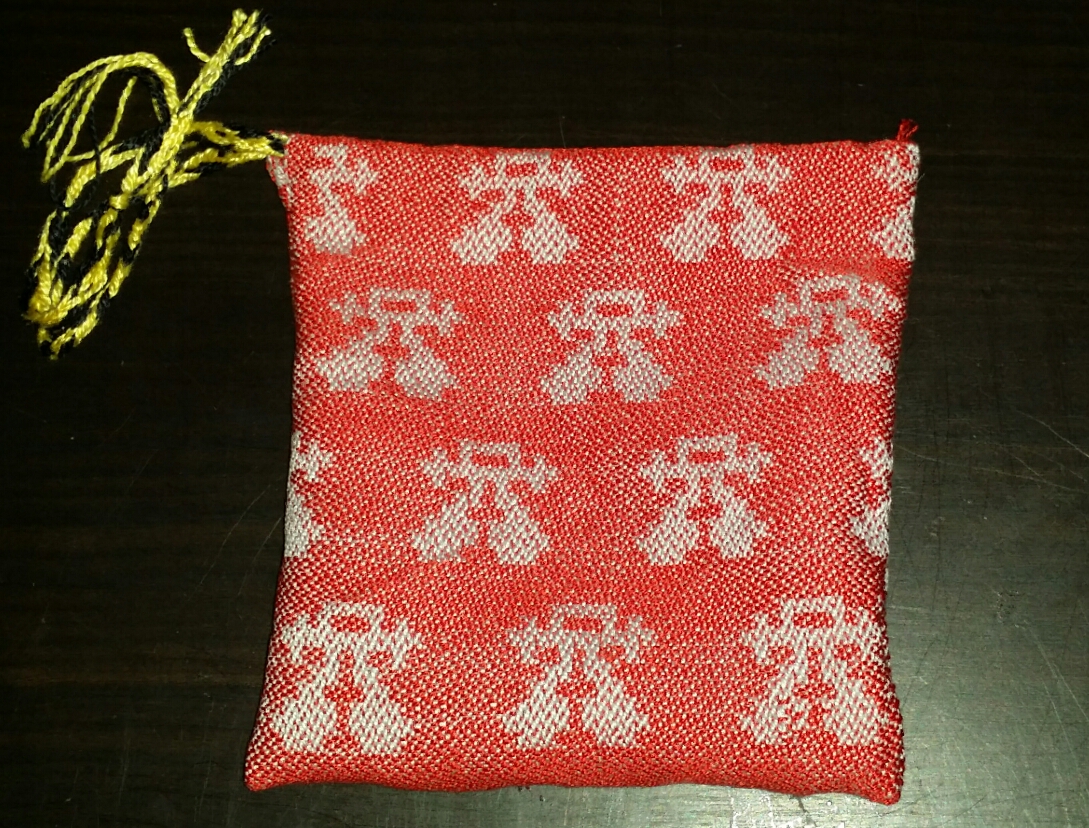 My second entry was a damask pouch, right, I wove for Margaret de Mey as a present to celebrate her elevation to the Order of the Pelican. This pouch was entered as heraldic display. My judges were very kind and as I have spoken to several heraldically inclined individuals, they have all commented on their love for heraldic display in items other than banners! The pouch itself was based on a heraldic purse on display at the British Museum and an article on Cote Simple, on aumonieres.
This project was very fun as well. The damask cloth was woven on my drawloom and was one of my first projects using the drawloom attachment. I had to do a lot of sampling to draft the design to get the water bugettes just right, but I go there in the end and the journey was well worth it.
My final entry was in the Research Paper category. This paper is thus far the culmination of many years of research on Medieval textiles and loom technology. I discovered that I have a vast library of books pertaining to Medieval textiles and learned many new things while reviewing the literature for this entry. I also visited the newly formed Clothworker's Centre in London to view a few new textiles to add to the paper. As part of the research paper, I included a number of samples of my own weaving to help people understand the various different weave structures I have documented and the weaving terminology. This entry was probably the most difficult entry, but again was a joy to complete and is a work of which I am very proud. I plan to bring the samples with me to events, so if you would like to see all the samples, please find me at events and I would be happy to let you peruse them.
Overall the competition was a rigorous, but fun experience. I look forward to helping our fine Royals in any special projects they would like completed and in encouraging Drachenwald's artists. If you have ever considered entering the competition, I would encourage you to do so. This was not my first time entering the Royal Artisan Competition. I have had some wonderful feedback along the way and have made many new acquittances from people judging my work and coming to ask questions or give compliments after the competition. If you have any questions about the competition or my experience, please ask!
The Royal Artisan Competition is a rigorous competition. I had to enter items in at least 3 broad categories over at least 2 events. The categories are now Culinary Arts, Fine Arts, Textiles Arts, Performance, Martial Arts, Decorative Sciences, Functional Sciences, and Research Papers. Within each category there are a number of criteria for specific entries. I hope you will find the explanation of my entries below helpful in understanding the criteria of the competition.
These hoods were exceptionally fun to make. I started with a simple herringbone weave, but got bored with straight treadling and decided to reverse the treadlining. I measured how far I wove before the first reversal and continued with this throughout the weaving. The effect is a nice herringbone wool with diamonds every 6".
The hoods are based on the Skjodlhamn find from a Norwegian harbor. The design is very close to the extant hood, for more detailed information on this find please see Løvlid's dissertation. The hoods are the closest thing I could find to a "Viking" hood, though they are a bit late to be considered Viking in the strictest sense, but they are within the period that my husband chose to recreate. These hoods are made from J.C. Rennie wool in grey (warp) and blue (weft). For more information on this project, see my blog entry here.
My second entry was a damask pouch, right, I wove for Margaret de Mey as a present to celebrate her elevation to the Order of the Pelican. This pouch was entered as heraldic display. My judges were very kind and as I have spoken to several heraldically inclined individuals, they have all commented on their love for heraldic display in items other than banners! The pouch itself was based on a heraldic purse on display at the British Museum and an article on Cote Simple, on aumonieres.This project was very fun as well. The damask cloth was woven on my drawloom and was one of my first projects using the drawloom attachment. I had to do a lot of sampling to draft the design to get the water bugettes just right, but I go there in the end and the journey was well worth it.
 |
| Photo courtesy of Lia de Thornegge |
Overall the competition was a rigorous, but fun experience. I look forward to helping our fine Royals in any special projects they would like completed and in encouraging Drachenwald's artists. If you have ever considered entering the competition, I would encourage you to do so. This was not my first time entering the Royal Artisan Competition. I have had some wonderful feedback along the way and have made many new acquittances from people judging my work and coming to ask questions or give compliments after the competition. If you have any questions about the competition or my experience, please ask!
Subscribe to:
Posts (Atom)